
Williamsburg Parole and Probation Compared
Parole and probation both place a person under rules in the community, but they begin in different ways. Parole is an early release from South Carolina Department of Corrections custody. The prison sentence continues while the person is supervised by the South Carolina Department of Probation, Parole and Pardon Services, commonly called DPPPS. Probation comes from a court sentence. It may follow a short custody term, but it can also be ordered without any state-prison stay. That difference explains why an SCDC record is not required for every Williamsburg County probation case.
Other DPPPS labels also matter. Community supervision can follow the incarcerated part of a no-parole sentence. Supervised reentry and supervised furlough are distinct legal programs, not alternate names for parole. A Williamsburg County record should be quoted as displayed because each status reflects a different legal basis and stage.
| Supervision type | How it starts | Best verification source |
|---|---|---|
| Parole | The Board grants early release from SCDC while the sentence continues. | DPPPS offender search, Board result, and local DPPPS office |
| Probation | A court orders community supervision as part of the sentence. | DPPPS offender search and the sentencing court record |
| Community supervision | A statutory supervision period follows incarceration for an applicable offense. | SCDC release record and DPPPS |
| Supervised reentry or furlough | A person enters the specific program authorized for the case. | The exact SCDC release type and DPPPS office |
- Parole
- Conditional early release from state prison while the sentence remains active.
- Probation
- Court-ordered supervision that does not always follow a prison term.
- Absconder
- A person whom the supervision agency reports as having stopped required contact or whose location is unknown.
- Discharge
- The formal end of a supervision obligation, not merely release from a facility.
Verify Williamsburg Post-Release Supervision
The official DPPPS Offender Search accepts first name, last name, SID number, county, and year of birth. The valid search combinations are important. A user may enter first and last name, SID alone, first name with birth year, last name with birth year, county with SID, county with first name, or county with last name. Select Williamsburg as the county when that is the known place of supervision. Names can repeat, so compare the SID and birth year whenever those fields are available.
DPPPS states that its results reflect the previous day. It also warns that a person no longer under supervision may not appear. A blank result does not establish that the person was never supervised, nor does it prove the date supervision ended. For information that must be current today, contact staff in the county of supervision. If the person was released from SCDC, compare the DPPPS result with the exact release type shown in the state corrections record.
- Gather the legal name, spelling variants, year of birth, and SID if known. Use the SID first because it is less prone to a same-name match.
- Run a valid field combination in the DPPPS search. Add Williamsburg County only when the supervision county is known.
- Read the displayed category and data date exactly. Do not turn probation, parole, community supervision, or supervised reentry into one generic label.
- Compare the result with the SCDC release entry or court sentence that created the supervision. Those records answer different parts of the timeline.
- Call the Williamsburg DPPPS office for a same-day status, a stale entry, or uncertainty about which local unit holds the case.
The official supervision search is shown below. Its named fields and previous-day warning are the reason a careful lookup records both the result and the date it was checked.
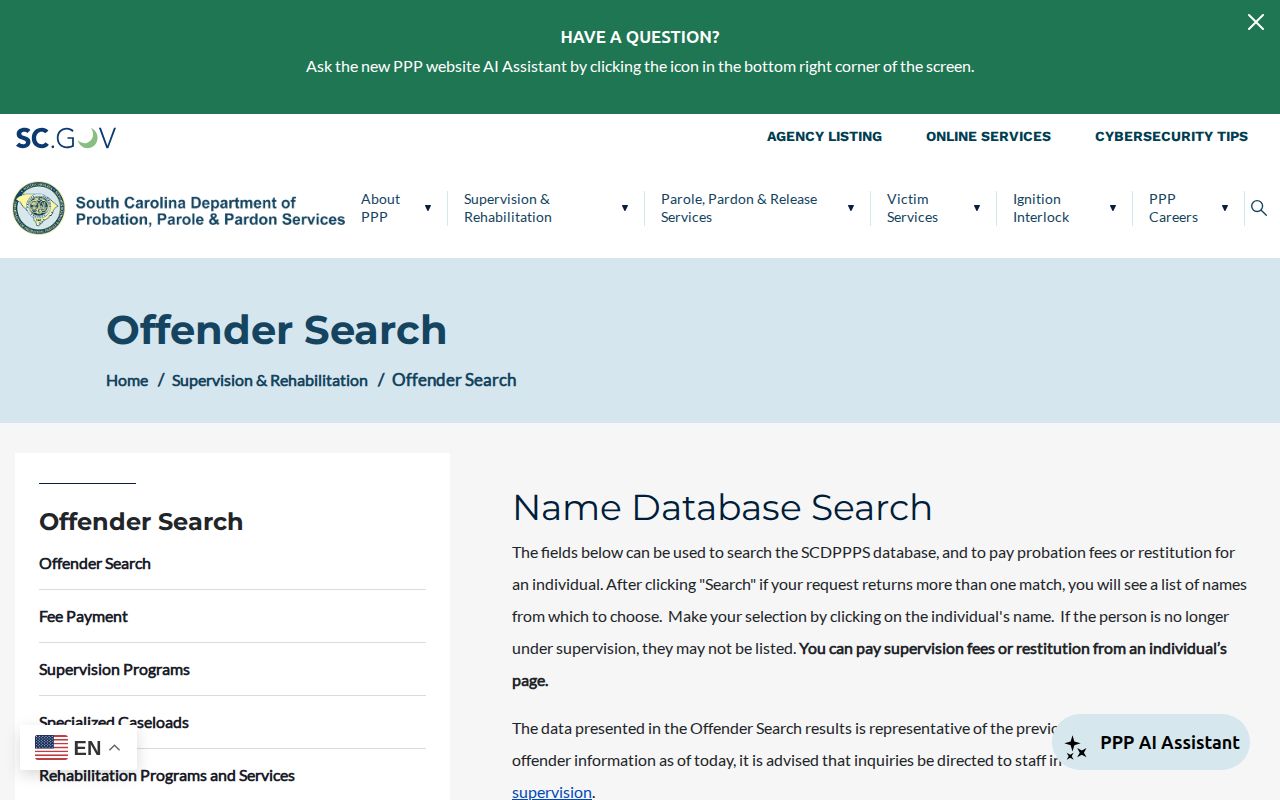
The screen supplies a focused starting point, while the local office remains the source for current Williamsburg County supervision questions.
Note: A DPPPS result supports supervision status as of its data date, not the exact time a person left custody.
Williamsburg County Supervision Office
The Williamsburg County DPPPS office is the local point for parole, probation, community supervision, supervised reentry, Jessie’s Law tracking, and supervised furlough matters assigned to the county. The office page names Wayne Davis as Agent in Charge. It also publishes live caseload totals, but those figures change and are not release counts. They show why “out of prison” may still mean that a person has an active legal status in the community.
A July 21, 2026 snapshot listed 134 probation cases, 7 parole cases, 7 community-supervision cases, 2 supervised-reentry cases, 8 Jessie’s Law tracking cases, and no supervised-furlough cases. These figures must stay tied to that date. They describe category caseloads on the local office page, not unique release events and not a count of people who left the Williamsburg County jail. The categories themselves are more useful than a total because they show several ways community supervision can continue after custody.
South Carolina DPPPS
Williamsburg County Office
147 West Main Street
Kingstree, SC 29556
Mailing: P.O. Box 527, Kingstree, SC 29556
Phone: 843-401-1140
The office page is pictured through its official directory entry. It separates local contact details from the statewide search and displays the supervision categories handled in Williamsburg County.
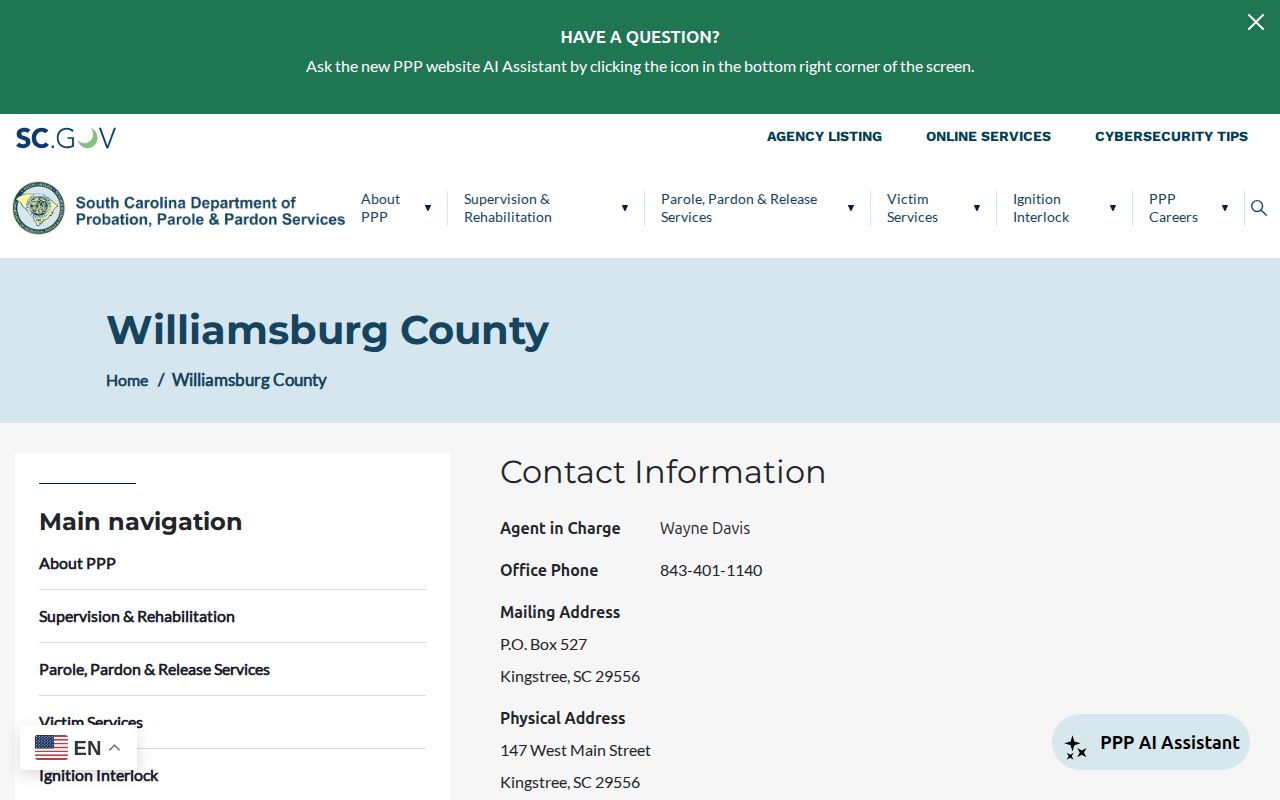
That local breakdown is the distinctive Williamsburg County layer. A dated category count can describe office workload, but it must never be presented as the number of people released.
Williamsburg Parole Hearing Records
Parole eligibility is not a release order. SCDC may show a Projected Parole Eligibility field, which can be an eligibility date or, in some cases, a scheduled hearing date. The person-specific hearing and results search accepts first name, last name, SCDC number, and hearing month. Valid combinations include first and last name, SCDC number alone, either name with month, or month alone. Schedules generally become searchable about thirty days before the hearing, but rescheduling and update delays are possible.
A Board outcome also needs precise reading. A conditional grant can require prerelease conditions before the person actually leaves SCDC. A rejection means there is no current grant, and the next review schedule depends on the offense and governing law. The Board’s live page carries the current calendar because calendar revisions can occur. Confirm departure separately in the SCDC Released Inmate Search and then check DPPPS for supervision.
Eligibility depends on the offense and governing sentence. Under South Carolina Title 24, Chapter 21, Section 24-21-610 generally places eligibility for a parole-eligible violent offense after one-third of the term or the mandatory minimum, whichever is longer. Other parole-eligible offenses generally use one-fourth. Life terms and terms over forty years generally use ten years, but the statute contains exclusions and special rules. A no-parole offense committed on or after the controlling effective date is generally ineligible for parole and instead may carry statutory community supervision.
After a denial, review timing also varies. The statute generally provides a two-year cadence for violent cases and annual review for nonviolent cases, with an exception for a specified older violent-offense group. The person-specific result controls. Hearing information can be reviewed through the official service, but a calendar entry shows only that a proceeding is set. It cannot supply the actual release date or prove that prerelease terms have been met.
The official parole services interface illustrates the fields used to locate a person-specific schedule or decision.
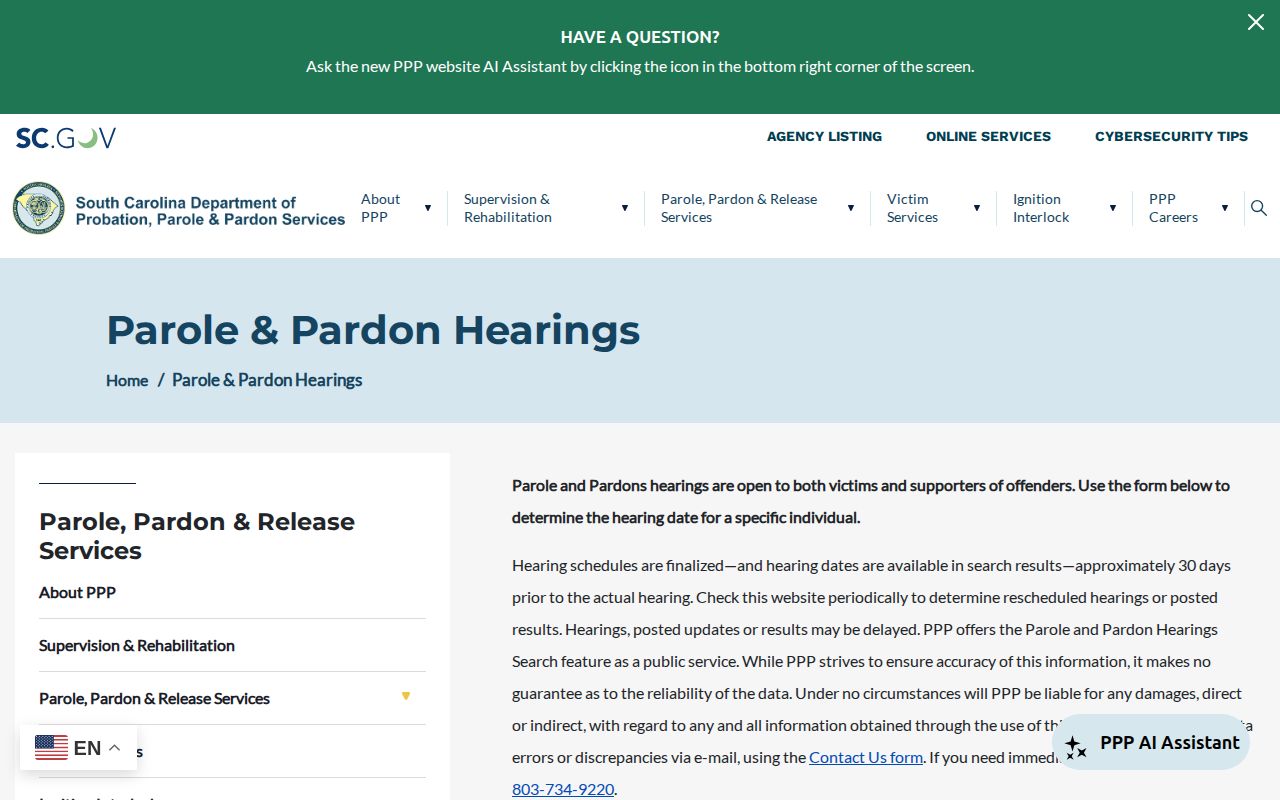
The result should be kept distinct from eligibility, actual physical release, and eventual discharge from Williamsburg County supervision.
Williamsburg Supervision Violations and Warrants
Supervision conditions come from the court, Board, statutes, and case instructions. They can require reporting, approved travel, treatment, payments, or compliance with other stated rules. The exact terms belong to the person’s order and supervision record. A violation allegation may lead to a warrant, hearing, modification, revocation, or new custody. It does not erase the earlier release event.
DPPPS publishes a statewide Most Wanted Offenders page with labels such as AT LARGE and CAPTURED. No Williamsburg entry was visible on August 1, 2026. That dated finding is not proof that Williamsburg County has no supervision warrant, because the statewide page is dynamic and is not a complete local warrant index. The confidential DPPPS tip line is 1-888-761-6175. Emergencies should go to 911.
An absconder label means the agency reports a loss of required contact or location, not that the person was never released. If a revocation returns the person to SCDC, a past released-list entry and a current-prison result can both be accurate. Search dates and source ownership resolve that apparent conflict.
Williamsburg Supervision Discharge Records
Supervision ends through a formal discharge, expiration, court action, or another result authorized for the case. Merely disappearing from the previous-day DPPPS search does not provide a discharge date. Ask DPPPS which record documents the end of its supervision, and use the sentencing court when the relevant action was judicial. For a state-prison timeline, preserve the SCDC ID, release type, release date, DPPPS status, and final discharge as separate fields.
The distinction is useful when reconstructing a Williamsburg County release. The county jail owns its movement record, SCDC owns state-prison release and sentence computation, the Board owns the parole decision, and DPPPS owns community supervision. The broader Williamsburg County released-inmate search explains how county, state, and federal custody trails remain separate. A person can be physically free from a cell yet still subject to supervision, and discharge is the event that closes that later stage.