
Williamsburg Projected and Actual Release
A projected release date is an agency calculation, not a record of completed movement. SCDC defines its Projected Release Date as the date on which it expects the person to satisfy all incarcerated terms, based on sentence type and the continued earning of work, education, and good-time credits at the current rate. The public interface may also call this a maxout date. A rule violation, amended sentence, restored credit, or other new information can change it.
Actual release is the event that ends the agency’s physical custody. A jail or prison movement record documents that event. Parole eligibility is different again. It identifies when a parole review may occur, and SCDC’s Projected Parole Eligibility can sometimes reflect a scheduled hearing. Neither eligibility nor a favorable Board action, standing alone, proves that the person left custody. Conditions, paperwork, and another agency’s hold can still intervene.
- Projected release date
- SCDC’s current estimate for satisfying all incarcerated terms under its calculation.
- Maxout
- The interface’s related term for the projected end of the incarcerated terms.
- Parole eligibility
- The point when an eligible case may be considered for parole, not an automatic release.
- Detainer
- A request or legal hold from another authority that may prevent release to the community.
Find Williamsburg Projected Release Dates
Begin with custody type. The SCDC Public Inmate Search covers people sentenced to and incarcerated by SCDC as of midnight the previous day. It does not cover a person serving only a county-detention sentence, someone on parole or probation, or an already released SCDC offender. Search by SCDC ID when possible. For a name search, test the legal name and spelling variants, then open the person’s detail and compare demographic and sentence information before relying on a date.
The current interface labels the field Projected Release Date. Its advanced search also offers Projected Release Date Start and Projected Release Date End. Record the exact label, value, access date, SCDC ID, and current status. Do not substitute admission, sentence start, parole eligibility, or an old actual release date. If the public detail lacks a needed movement or computation, contact SCDC rather than treating an empty field as an answer.
- Identify whether the person is a county detainee, county-sentenced inmate, SCDC prisoner, or federal prisoner. Each system owns a different computation.
- Obtain the sentencing or commitment order. Note every count, the unsuspended term, and whether terms run concurrently or consecutively.
- For SCDC custody, search by SCDC ID and open the full record. Copy the displayed projected date and parole-eligibility field separately.
- For a Williamsburg County jail sentence, ask the jail for the commitment, jail-credit ledger, applicable local good-conduct credit, and any hold. Do not use the state-prison projection for that calculation.
- Check for amended orders, detainers, disciplinary credit changes, and parole action. Ask the record owner to resolve any arithmetic conflict.
- After the date passes, confirm the actual event in the agency’s release or movement record rather than assuming departure occurred.
The official SCDC offender-search interface shows the state-prison search path and is distinct from both the Williamsburg County jail and the released-person list.
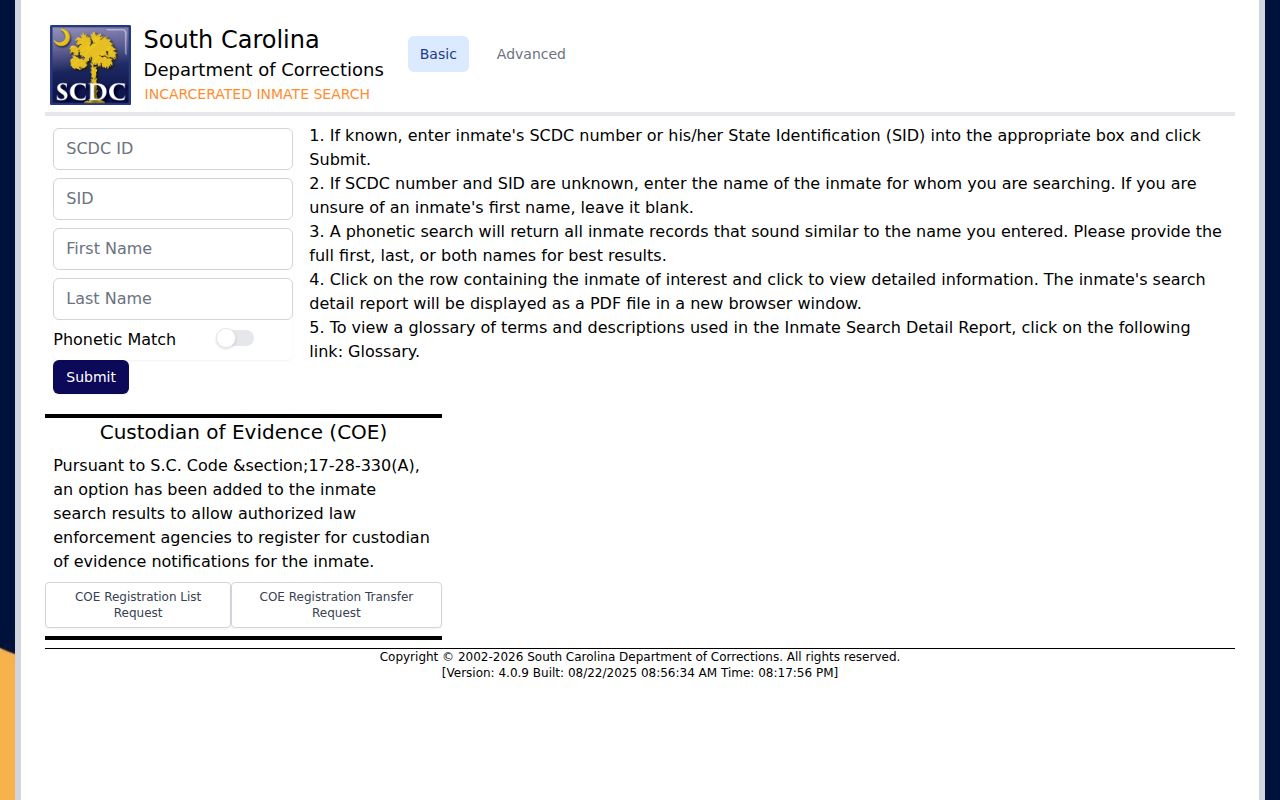
This source is appropriate only when SCDC owns the sentence record. A county booking that ended in bond, dismissal, or a short local term may never appear there.
Note: The SCDC current-custody search reflects the previous midnight, so a later movement may not yet appear.
Williamsburg SCDC Calculator Limits
SCDC provides a public release-date calculator, but its stated limits are decisive. It is a general guideline based on current law and assumes the earliest possible outcome with all possible credits. It cannot calculate the release date of a person who has already been sentenced. It also does not handle Youthful Offender Act cases and does not account for prior or later convictions. A calculator output must never replace the projected field on an actual SCDC record.
The tool helps explain how sentence type and potential credit can affect time. It does not know the individual’s full credit ledger, discipline history, every commitment, or every hold. Questions about an existing record go to SCDC Inmate Records at 803-896-8531. If the calculator and the official detail differ, use the agency record and request clarification. Never publish a hand calculation as an official Williamsburg County projected release date.
The calculator’s official disclaimer is captured below. Its warnings are part of the tool, not a minor technical note.
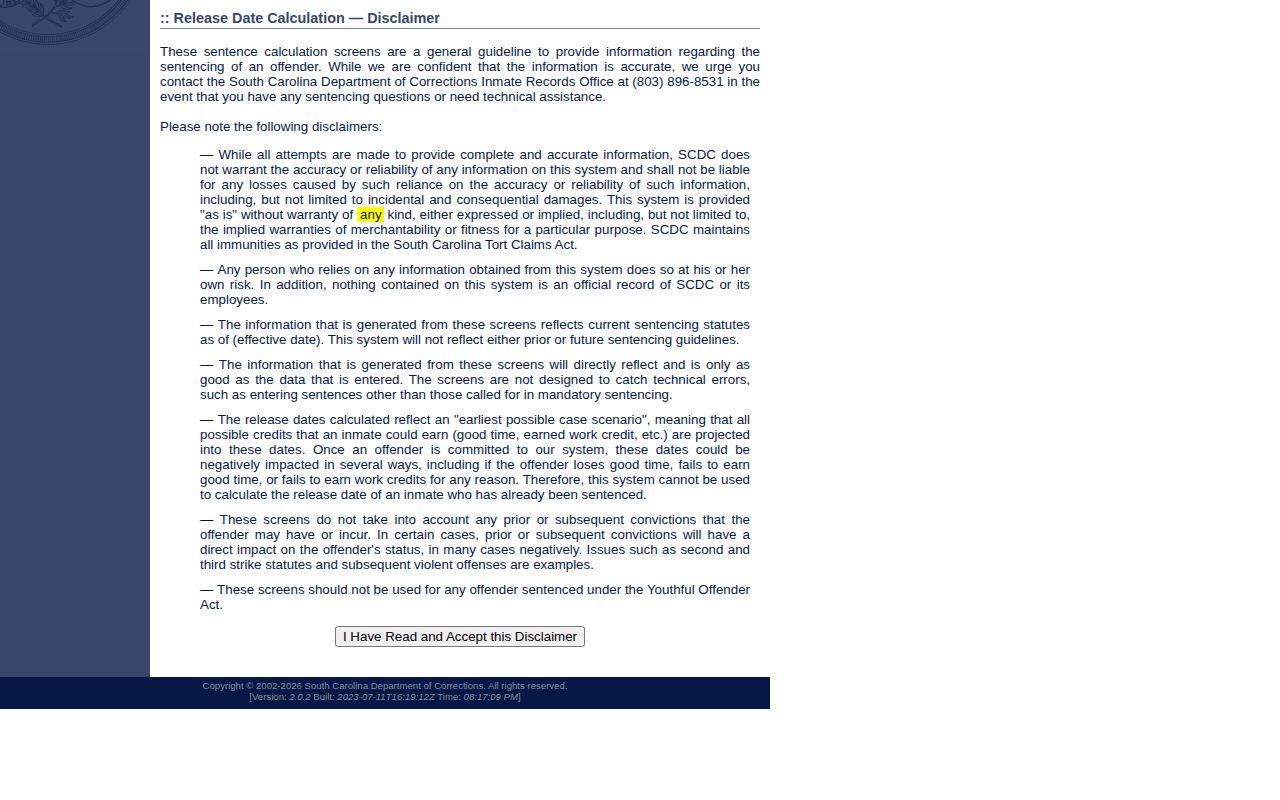
The disclaimer makes the correct use clear: learn the possible framework, then rely on SCDC’s person-specific computation for the actual record.
Williamsburg Release Credits and Statutes
South Carolina’s credit rules appear in Title 24, Chapter 13. Section 24-13-100 defines a “no parole offense” by felony class or, for an unclassified offense, by its maximum term. Offense date and classification matter. Section 24-13-150(A) then provides that a person convicted of an applicable no-parole offense generally cannot be released, discharged, or placed in community supervision until serving at least 85 percent of the actual prison term imposed. Credits cannot reduce custody below that floor.
The 85-percent rule is not universal. It applies to qualifying no-parole sentences, subject to the statute. Section 24-13-210(A) allows a compliant parole-eligible SCDC prisoner twenty days of good-conduct credit for each month served. Subsection (B) provides three days per month for a no-parole offender while preserving the 85-percent floor and excluding specified terms. Under subsection (D), SCDC or the responsible local official may forfeit credit. These distinctions prevent a single percentage from being applied to every state prisoner.
Productive-duty and education credits are addressed by Section 24-13-230. A qualifying parole-eligible SCDC prisoner may earn from zero to one day for each two days of participation, with combined credits capped at 180 days per year. A qualifying no-parole prisoner may earn six days per month, capped at 72 days per year, subject to exclusions and the same 85-percent floor. Section 24-13-175 directs that sentence calculations use a 365-day year. Section 24-13-125’s 80-percent work-release threshold for a no-parole offender is a different rule and must not be confused with the 85-percent custody floor.
Williamsburg County Sentence Computation
A person serving a sentence at Williamsburg County Detention Center follows a county computation, not the SCDC projected-date field. Section 24-13-210(C) separately allows one day of good-conduct credit for every two days served by a qualifying person sentenced to a local detention facility or public works program. The conduct requirements and the facility’s ledger control. Subsection (D) permits forfeiture by the responsible local official.
Obtain the commitment order and ask the jail to identify the credit used. The order should show the term and may address credit for time already held. Confirm whether other counts run at the same time or one after another. Then ask whether another county, SCDC, the U.S. Marshals Service, or ICE has a hold. Completion of the Williamsburg sentence does not prove release into the community if another authority receives the person.
A pretrial detainee is different. There is no sentence term to reduce with good-conduct credit. Bond, dismissal, acquittal, a later sentence, or a transfer determines the next event. The court docket can show the legal order, but the detention center’s movement record supplies the actual out-processing time and destination. Call Williamsburg County Detention Center at 843-355-9696 when current custody versus transfer must be clarified.
This local calculation is also why the SCDC calculator should not be used for someone serving only a Williamsburg County sentence. County staff have the booking dates, court commitment, facility credit ledger, and movement information needed to explain the official figure. Ask for the existing records and the code key for any unexplained entry. A private arithmetic estimate cannot reveal an unrecorded hold or replace the responsible official’s calculation.
Why Williamsburg Release Dates Change
A sentence projection is built from several inputs that may change at different times. The court owns its sentence and amended orders. SCDC owns the state-prison computation and credit ledger. The county jail owns a local commitment and movement record. When two sources conflict, send the question to the office that owns the disputed field rather than averaging the dates.
| Factor | Possible effect | Record to check |
|---|---|---|
| Jail or prior-custody credit | Credited time can change the remaining term. | Commitment order and agency credit ledger |
| Concurrent or consecutive terms | Sentence structure changes how multiple counts combine. | Sentencing and amended orders |
| Good-time loss or restoration | A disciplinary action may move the projection later; restoration may revise it. | SCDC or county credit record |
| Work or education credits | Only credits actually earned and legally allowed affect the agency calculation. | SCDC projected-date detail |
| Parole action | Eligibility, hearing, grant, and effective release remain separate stages. | SCDC field and Board result |
| Detainer or new commitment | The sentence may end without release to the community. | Movement record and receiving-agency record |
| Amended court order | A changed term or credit directive requires recalculation. | Certified court order and agency update |
Confirm Williamsburg Actual Release Dates
For state custody, SCDC’s separate Released Inmate Search requires a release-date range and county. Williamsburg appears with county code 45. Results can show SCDC ID, name, sex, race, age, sex-offender indicator, release date, release type, and county. Labels observed in a Williamsburg-filtered search include RELEASED, PROBATION, and SUPV RE-ENTRY. The last two show that incarceration ended into another legal status, not that all obligations ended.
The official SCDC released-inmate instructions are shown below. This released-first channel must remain separate from the current-prison search.
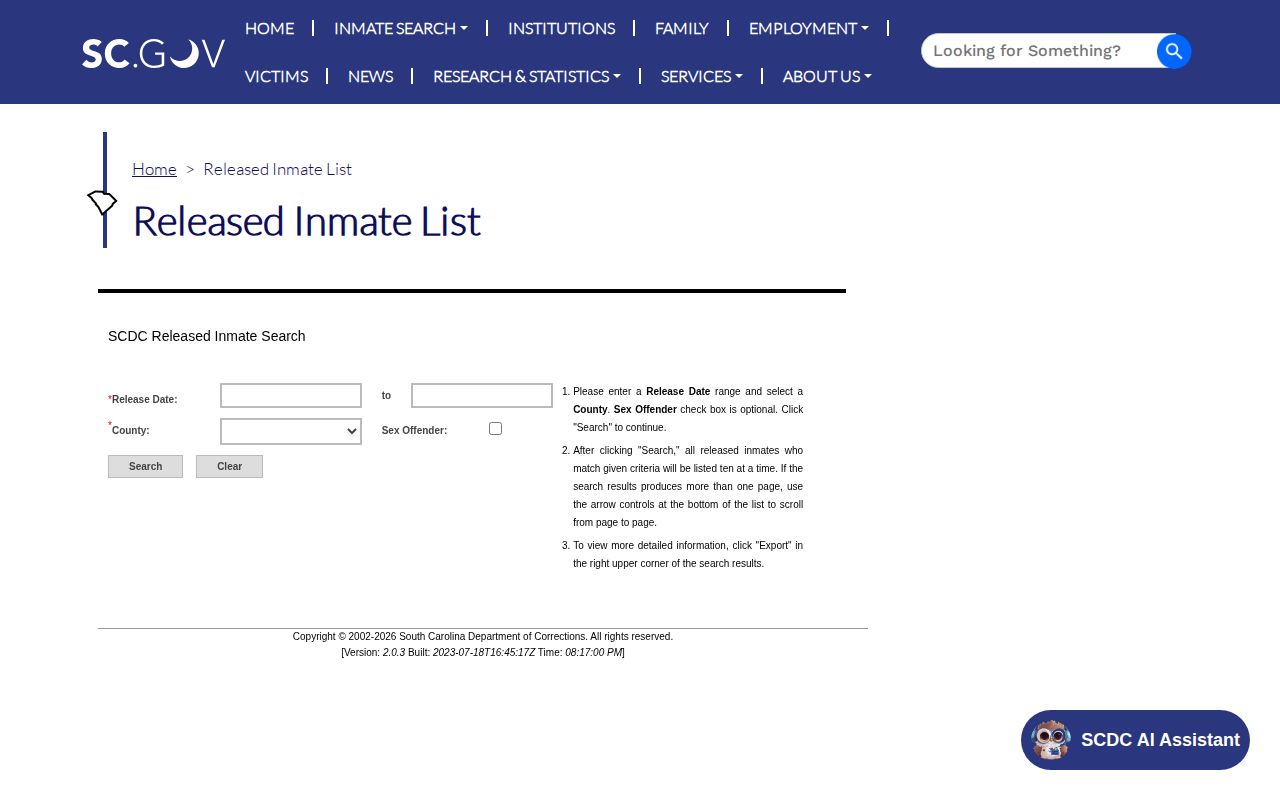
The released list confirms an SCDC event, not a Williamsburg County jail release. For a county event, request the detention center’s booking and movement record. For a pending custody-change alert, use the VINELink Check, but confirm important timing with the record owner. A VINE alert reports a data event and is not the same document as the completed release log.
The full Williamsburg County released-inmate search routes county, state, and federal records to their correct agencies. That system split matters here because FCI Williamsburg is federal. Its projected and actual dates belong to the Federal Bureau of Prisons, not SCDC or the county jail.
Note: Keep the access date with every projection because later credit, court, parole, or detainer information may change it.